Begin with a question that changes practice
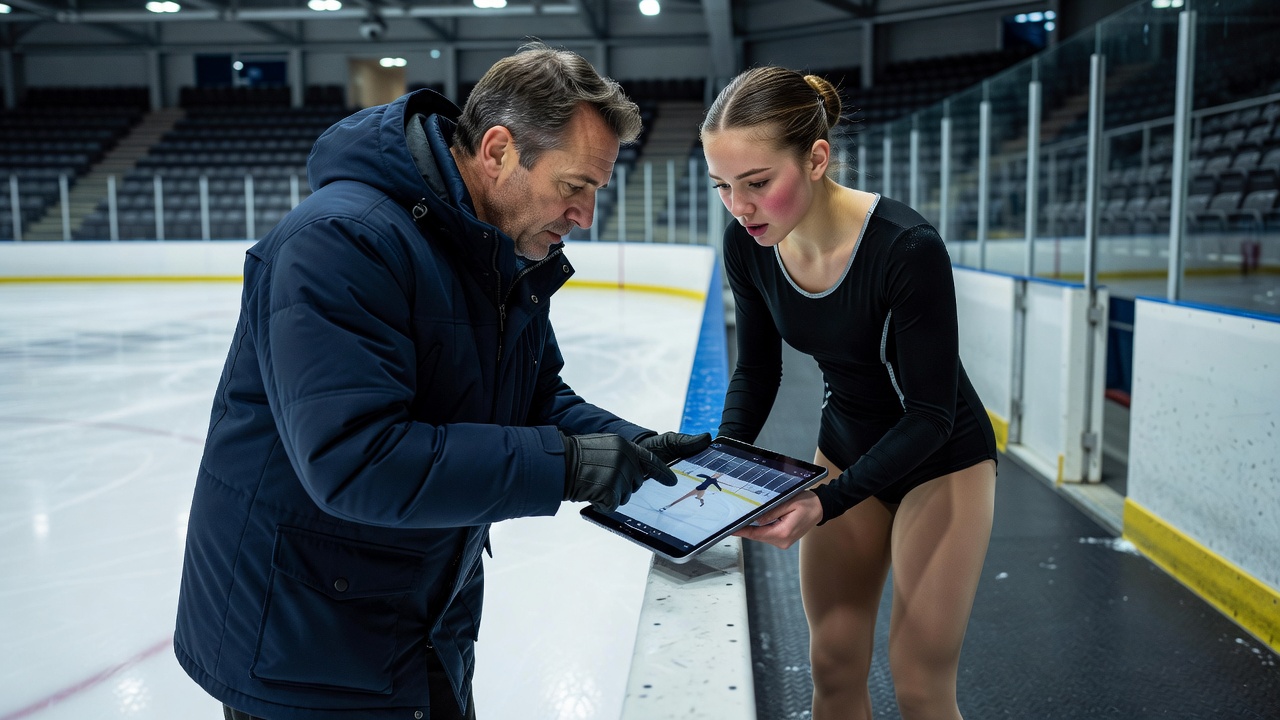
Before recording, agree what the coach and skater want to understand. The question might concern the approach to a jump, the relationship between a movement and a musical phrase, or the consistency of a repeated entry. A narrow question makes it easier to choose a camera position, select a useful clip and decide what happens next. Recording an entire session without a review plan often creates an archive rather than useful feedback.
The athlete's own account matters. Ask what the attempt felt like before showing the replay. Comparing sensation with observation can support learning, whereas immediately replacing the skater's experience with a screen may encourage dependence on external confirmation. The right balance varies with the task, the athlete and the stage of learning. A coach should explain why feedback is being offered at that moment.
Use video with honest limitations
A fixed camera can make comparisons easier, but an image is still a view from one position. Perspective, distance, lighting, motion blur and an obstructed line of sight affect interpretation. A clip that looks convincing may not support a precise claim about body position or rotation. If a decision depends on measurement, the method needs appropriate calibration and a clear account of uncertainty.
Simple equipment can be entirely adequate for a well-defined observation. Tools such as Kinovea can support video review, but software features do not validate the conclusions drawn from them. Distinguish an annotation used to guide a coaching conversation from a formal biomechanical measurement. When the question exceeds the team's expertise, involve a suitably qualified practitioner rather than presenting a convenient number as an established fact.
Choose feedback timing deliberately
Stopping after every attempt can interrupt rhythm and consume the very ice time the technology was meant to improve. Some tasks benefit from immediate review; others may be better served by a small block of attempts followed by a short discussion. There is no universal feedback frequency suitable for every skater. Agree a pattern, observe whether it supports the task and change it when necessary.
Keep the outcome of a review manageable. A long list of visible differences can leave an athlete unsure where to direct attention. The next attempt usually needs an agreed priority rather than a complete description of everything that happened. Where a safety concern emerges, the decision may be to stop or change the exercise, not to collect more examples in pursuit of a cleaner clip.
Separate useful trends from noisy numbers
Wearables, jump counters and timing systems can describe aspects of training, but different devices may define an event differently. Ask what is measured directly, what is inferred and under which conditions the system was tested. A change in device placement, software or recording conditions may make comparisons misleading. A facility should be willing to explain these limitations rather than relying on the appearance of precision.
Monitoring should support conversations, not create an automatic ranking of effort or readiness. A single session can be affected by travel, illness, changing tasks and the skater's broader circumstances. Clinical decisions require appropriately qualified professionals. For broader professional context, the British Association of Sport and Exercise Sciences and the UK Sports Institute publish information about sport science and performance support; their existence does not imply endorsement of a particular device.
Make consent and access part of the system
Before filming, establish permission, the purpose of recording, who can access it and when it will be deleted. Shared sessions can capture other skaters, including children. Follow the facility's recording policy and applicable safeguarding procedures. An athlete agreeing to coaching review has not necessarily agreed to social media publication, promotional use or uploading footage to an unrelated third-party service.
A practical setup includes secure storage, appropriate access controls and a route for raising concerns. The Information Commissioner's Office provides UK data protection guidance. Coaches and facilities should obtain suitable advice for their actual processing activities, particularly where footage, health information and children's data intersect. Convenience is not a substitute for a defensible handling process.
Finish with a small, usable record
At the end of the session, note the question, the observation, the agreed adjustment and anything that needs review. Keep interpretation separate from raw measurements. A short record that the next coach can understand is more valuable than a crowded dashboard no one checks. The test of a feedback environment is whether information arrives in time, at an appropriate level of detail, and helps the skater practise with greater clarity.